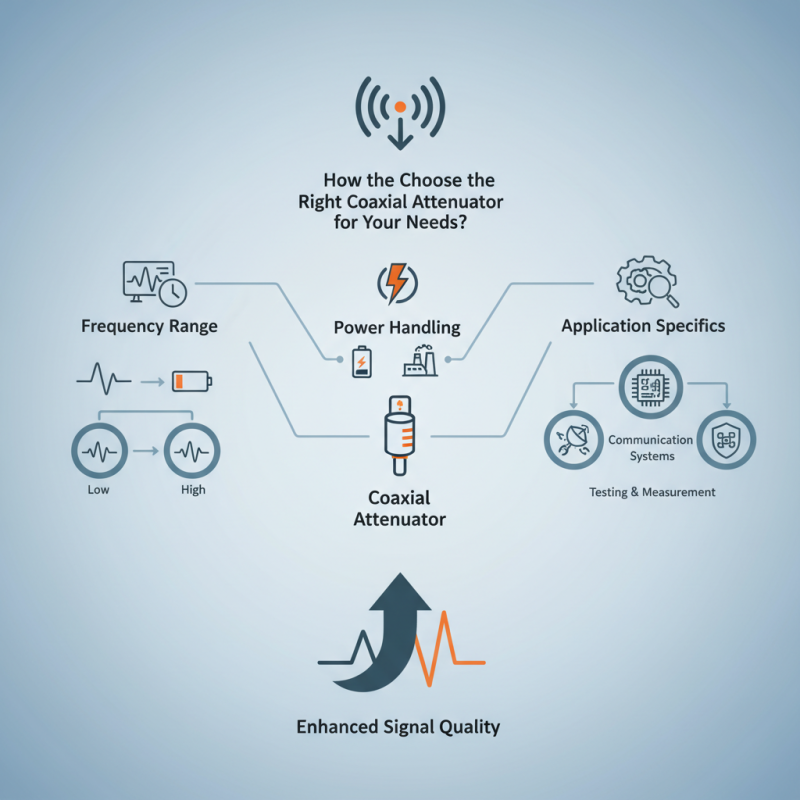
How to Choose the Right Coaxial Attenuator for Your Needs?
Choosing the right Coaxial Attenuator can be challenging. Understanding your specific needs is crucial. Different applications demand different specifications.
A coaxial attenuator helps reduce signal strength. This component is vital in many communication systems. However, not every attenuator suits every scenario. You'll find various options on the market, each with unique features.
Consider factors like frequency range and power handling. Some users overlook these details. Inadequate attention can lead to poor performance. It’s essential to assess your system's requirements properly. Making the right choice can enhance signal quality. Yet, many still face confusion. A thoughtful approach can lead to better decisions.
Understanding Coaxial Attenuators: Types and Functions
Coaxial attenuators are essential devices in many communication systems. They help control signal strength, which is crucial for efficient performance. Understanding their types makes your selection easier. There are fixed and variable attenuators. Fixed types provide a constant level of attenuation. They simplify the design of your system. Variable attenuators, on the other hand, allow you to adjust signal levels as needed. This flexibility is vital in dynamic environments.
When choosing an attenuator, consider bandwidth and power handling. These specifications ensure the device meets your performance needs. Selecting the wrong type can lead to signal loss or distortion. It’s helpful to match the attenuator’s capabilities with your system requirements. Pay attention to connectors as well. They need to align with your existing setup to avoid compatibility issues.
Not all applications require high-end solutions. Sometimes basic options will suffice. You might find yourself overwhelmed by choices. Take your time to reflect on your specific use cases. Think about where you can compromise on quality versus budget. This approach can save both time and resources.
Key Specifications to Consider When Choosing a Coaxial Attenuator
When selecting a coaxial attenuator, understanding key specifications is crucial. Attenuation value stands out as the first metric. It measures the signal reduction, typically in decibels (dB). Choosing the right dB rating can significantly impact the performance of your system. A study noted that a 10 dB attenuator reduces power by about 90%. Knowing your required attenuation helps in maintaining signal quality.
Another important specification is frequency range. Attenuators operate effectively within specific frequencies. Common ranges include 1 MHz to 18 GHz. Using an attenuator beyond its optimal range may introduce unwanted reflections. The return loss parameter, which indicates how much signal is reflected back, is essential too. Industry data suggests that a return loss of 20 dB is usually acceptable for minimal reflection issues.
Power handling capability shouldn't be overlooked. It determines how much power an attenuator can safely handle. Selecting one that exceeds your system's power requirements prevents heat buildup and device failure. Additionally, the connector type matters. Different setups require different connectors, often leading to compatibility issues. Ensuring the right connector type can save time and installation headaches. Remember, consideration of all these specifications is vital for optimal operation.
Calculating Attenuation: How Much Loss Do You Need?
When choosing a coaxial attenuator, the key is understanding how much attenuation you truly need. The goal is to balance signal strength and clarity. Commonly used coaxial attenuators can achieve attenuation levels ranging from 1 dB to 30 dB. However, the exact requirement varies depending on the specific application. For instance, data shows that many telecommunications systems operate optimally with about 10 dB of attenuation.
Calculating the right amount of loss is crucial for performance. A signal too strong can cause distortion, while a weak signal may lead to poor transmission. Many experts recommend monitoring your system's gain structure. Too much attenuation can overshadow the benefits of signal amplification. Conversely, too little can result in interference. A study by the IEEE highlights that in RF communication, an optimal range is vital. Achieving a loss within 3-6 dB often yields the best results.
Consider also the frequency range. Not all attenuators perform equally across different frequencies. You may need to factor in the specific frequency response your setup demands. If the wrong attenuator is chosen, issues may arise. Low-frequency signals require different handling than high-frequency ones. Keep in mind, experimentation may be necessary. Sometimes, it’s a trial-and-error process to find the perfect fit.
Material Selection: Impact of Construction on Performance
The selection of materials in coaxial attenuators significantly impacts their performance. Common materials include aluminum, brass, and plastic. Each offers unique properties that affect durability, temperature stability, and signal integrity. For instance, brass provides superior conductivity, enhancing signal performance. According to a 2022 report by the International Electrotechnical Commission, using high-quality brass can reduce signal loss by up to 15%.
Construction quality also plays a critical role. Any gaps or poor soldering can introduce unwanted noise. The attenuator must resist fluctuations caused by temperature changes. A well-constructed attenuator made from robust materials can withstand these changes without affecting performance. Some reports highlight that over 20% of performance issues stem from construction flaws.
**Tips:** When choosing an attenuator, consider environmental factors. Will it face high temperatures or significant vibration? A robust material might be essential. Look for independent testing data to verify performance claims. Always prioritize quality over cost for critical applications. This approach can prevent future complications and ensure reliable operation.
How to Choose the Right Coaxial Attenuator for Your Needs? - Material Selection: Impact of Construction on Performance
| Attenuator Type | Material | Frequency Range (GHz) | Power Rating (W) | Insertion Loss (dB) | Temperature Range (°C) |
| Fixed Attenuator | Alumina | DC - 18 | 0.5 | < 0.3 | -55 to +125 |
| Variable Attenuator | Copper | DC - 12 | 1 | < 0.5 | -40 to +85 |
| Optical Attenuator | Glass | 1000 - 1600 | < 0.1 | < 0.2 | -20 to +70 |
| Coaxial Capacitor | Polypropylene | DC - 10 | 0.25 | < 0.4 | -55 to +85 |
Common Applications of Coaxial Attenuators in Industry
Coaxial attenuators play a crucial role in various industries. They help reduce signal strength, ensuring proper functioning of devices. This is essential for applications in telecommunications, broadcasting, and radio frequency testing.
In telecommunications, these attenuators are vital. They protect sensitive equipment from overload. This helps maintain signal integrity. In broadcasting, they assist in managing output levels to ensure clear transmission. Without proper attenuation, signals can distort, leading to poor audio and visual quality.
Tips: Always consider the frequency range. This ensures compatibility with your system. Check the power rating to avoid damage. Selecting the wrong attenuator can lead to reflections and loss. It's important to test the setup after installation. Minor adjustments might be necessary. Unforeseen issues can arise during operation, so stay vigilant.
In radio frequency testing, attenuators provide a controlled environment. This is crucial for accurate measurements. Engineers rely on them to simulate real-world conditions. They help in troubleshooting and optimizing products. Reflect on your applications regularly. Your needs may change over time, and so should your equipment.