Top Hot Isostatic Pressing Manufacturers in China
China’s Hot Isostatic Pressing market deserves a careful comparison, not a quick ranking. A HIP system combines high temperature and isostatic gas pressure to reduce internal porosity in suitable materials. That sounds straightforward. In practice, results depend on vessel design, temperature uniformity, pressure control, and the selected cycle.
Powder-metallurgy expert Randall M. German has written extensively about densification. Paraphrasing a principle from his work: “Reliable densification depends on controlling the process, not pressure alone.” This is a paraphrase, not a verbatim quotation. It points to a useful question for buyers: can a manufacturer demonstrate stable, repeatable process control?
This guide examines Chinese manufacturers through practical criteria. These include equipment range, working-zone dimensions, maximum operating conditions, automation, service support, and documented quality procedures. A large vessel may suit aerospace components, while a smaller system may better fit research or specialized production. Neither is automatically the better choice. Ask how suppliers validate temperature uniformity and maintain pressure over time. Request references for applications close to your own.
Catalogs can make every system look capable. That is not enough. Published specifications may not reveal commissioning quality, spare-parts lead times, or the skill of local service teams. Those details deserve scrutiny, and this comparison cannot replace factory audits or technical trials. The manufacturers covered here offer different strengths, but buyers should verify claims against their materials, part geometry, and production goals before choosing a partner.
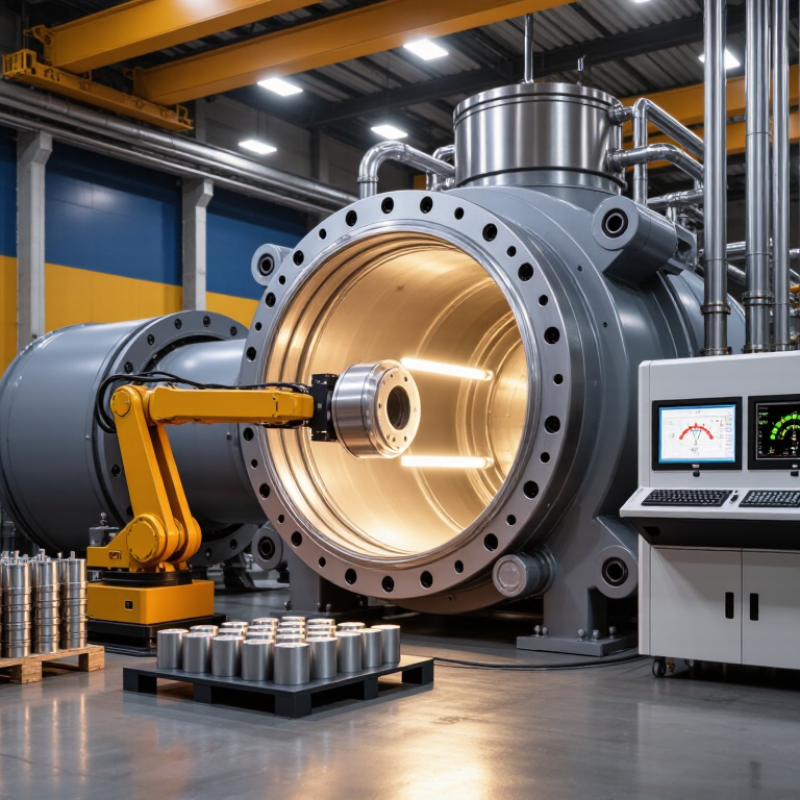
Hot Isostatic Pressing: Definition and Role in Chinese Manufacturing
Hot isostatic pressing, or HIP, applies high temperature and isostatic gas pressure inside a sealed vessel. The pressure acts from every direction. It closes internal pores in metal and ceramic parts, improving density and fatigue performance. A turbine component may undergo HIP after additive manufacturing, when tiny voids remain beneath a smooth surface. The process can also support diffusion bonding. It is not a cure-all: poor powder quality or unsuitable parameters can still limit the result.
China’s manufacturing scale makes HIP relevant to aerospace, energy, tooling, and medical-device supply chains. UNIDO’s International Yearbook of Industrial Statistics 2024 puts China at about 31% of global manufacturing value added in 2022. That scale creates demand for repeatable processing and inspection, not just larger presses. Operators must control temperature, pressure, hold time, and cooling; small variations may affect the finished part. A practical qualification plan checks density and mechanical properties against the component’s intended service. HIP adds cost and cycle time, too. Its value depends on whether fewer defects and longer service life justify them.
Top Hot Isostatic Pressing Manufacturers in China - Hot Isostatic Pressing: Definition and Role in Chinese Manufacturing
| Dimension | Industry Fact | Relevance to Manufacturing |
|---|---|---|
| Process definition | Hot isostatic pressing (HIP) combines elevated temperature with high, uniformly applied gas pressure, commonly using argon, to densify materials. | It can reduce internal porosity in castings, powder-metallurgy products, and many metal parts made by additive manufacturing. |
| Typical pressure range | Commercial metal HIP cycles commonly use pressures in the approximate range of 100–200 MPa; the selected pressure depends on the material, part, and process specification. | Equipment selection depends on the required working pressure, vessel size, temperature, and production volume. |
| Temperature and cycle | HIP temperature and hold time are material-specific. A cycle typically includes heating and pressurization, a controlled hold, and cooling and depressurization. | Qualified process recipes help balance densification, microstructure, dimensional stability, and productivity. |
| Materials processed | Applications include nickel-based superalloys, titanium alloys, stainless steels, tool steels, and selected ceramics and powder materials. | Manufacturers need material-specific process knowledge because different alloys and ceramics require different temperature, pressure, and atmosphere controls. |
| Castings and powder metallurgy | HIP is used to close internal defects and improve density in suitable cast and powder-metallurgy components. | It supports production of high-integrity components for demanding mechanical and thermal service conditions. |
| Additive manufacturing | HIP is used as a post-processing option for certain additively manufactured metal parts to reduce internal porosity; it does not replace design, build control, or inspection. | HIP service providers may support aerospace, energy, medical, and industrial AM supply chains, subject to part and application requirements. |
| Equipment capability | Relevant equipment factors include hot-zone dimensions, maximum operating temperature, working pressure, temperature uniformity, loading method, and process monitoring. | These factors determine which part sizes, materials, and production schedules a facility can handle. |
| Quality verification | Verification may include recorded cycle data and appropriate inspection, such as dimensional checks, metallography, or non-destructive testing, depending on the part specification. | Buyers should assess process traceability, inspection capability, and qualification evidence alongside equipment specifications. |
| Supplier comparison | A meaningful comparison considers verified capacity, material experience, part-size limits, process control, quality documentation, and delivery capability. | These criteria provide a practical basis for evaluating HIP equipment makers and processing-service providers without relying on unsupported rankings. |
Note: HIP parameters vary by material, component geometry, and qualification requirements; confirm the applicable process specification with the equipment supplier or service provider.
Related Posts
-
How Does Hot Isostatic Pressing Work?
-
Why Use the Hot Isostatic Pressing Process?
-
What Is a Hot Isostatic Pressing Machine?
-
What Is Hot Isostatic Pressing and How Does It Work?
-
Why Choose Hip Isostatic Pressing for Global Sourcing?
-

Innovative Industry Applications of Hot Isostatic Pressing Transforming Manufacturing Processes